Introduction
In the vibrant economic landscape of Rajkot, many of us dream of a secure financial future. Whether it's planning for your children's education, buying that dream home, or ensuring a comfortable retirement, smart investing is key. Among the various investment avenues, mutual funds have emerged as a powerful and popular choice for both seasoned investors and beginners alike. They offer a simple way to invest in a diversified portfolio of stocks, bonds, or other securities, managed by professionals.
However, with thousands of mutual fund schemes available, picking the "right" one can feel daunting. It’s not just about chasing the highest returns; it’s about choosing a fund that truly aligns with your unique financial aspirations and comfort level. This guide will demystify the process, helping you understand the crucial factors to consider so you can make informed investment decisions.
Why This Matters for People in Rajkot
Rajkot, a city known for its entrepreneurial spirit and growing economy, sees its residents actively seeking avenues for wealth creation. From business owners growing capital to families planning long-term security, sound financial planning is universal. While national trends influence the market, your personal investment journey is deeply rooted in your local context and goals.
For individuals and families across Rajkot and wider Gujarat, understanding mutual funds means empowering yourselves. It means securing your children’s higher education, possibly in esteemed institutions, or planning for a comfortable post-retirement life right here in your home city. It could also mean having the capital to expand your business or achieve other significant life milestones.
Ignoring the principles of mutual fund selection can lead to suboptimal returns, unnecessary risks, or even missing opportunities. That’s why having a clear strategy, tailored to your specific situation, is essential for achieving your financial dreams in Rajkot.
Key Factors to Consider When Choosing a Mutual Fund
Selecting a mutual fund isn't a one-size-fits-all decision. It requires a thoughtful evaluation of several factors that ultimately dictate whether a fund is a good fit for you. Let's break down these critical considerations:
1. Define Your Financial Goals
Before you even look at a fund, look inwards. What are you investing for? Your goals provide the compass for your investment journey. Are you saving for a down payment on a house in Rajkot in 3 years (short-term)? Or is it for your child's university education in 15 years (long-term)? Perhaps it's retirement planning for the next 25 years. Clearly defined goals will help determine the amount you need to invest, the timeframe, and consequently, the type of fund suitable for you.
- Short-Term Goals (1-3 years): Focus on low-risk debt funds or liquid funds.
- Medium-Term Goals (3-7 years): Consider balanced or hybrid funds.
- Long-Term Goals (7+ years): Equity funds can offer significant growth potential, enduring market fluctuations over time.
2. Assess Your Risk Tolerance
How much risk are you comfortable taking to achieve your returns? This is a deeply personal question. Are you okay with potential volatility for higher growth (aggressive)? Or do you prefer steady, albeit lower, returns with minimal risk (conservative)? Your risk appetite should align with the fund's risk profile.
- Conservative Investors: May prefer debt funds or fixed deposits.
- Moderate Investors: Often find hybrid funds or large-cap equity funds suitable.
- Aggressive Investors: Might opt for mid-cap, small-cap, or thematic equity funds for potentially higher returns, understanding the associated higher risks.
It's vital to be honest about your comfort level, as making investment choices that keep you awake at night is counterproductive.
3. Understand Your Investment Horizon
Your investment horizon is simply the length of time you plan to stay invested. It's closely linked to your financial goals and risk tolerance. Longer horizons generally allow you to take on more risk, as you have time to recover from market downturns. Short horizons necessitate lower-risk investments.
- A 10-year investment horizon for a child's education fund gives you more flexibility than a 2-year horizon for a car purchase.
- Equity funds perform best over longer periods (5-7 years minimum) to average out market volatility.
4. Explore Different Mutual Fund Types
Mutual funds come in various categories, each designed to meet different objectives:
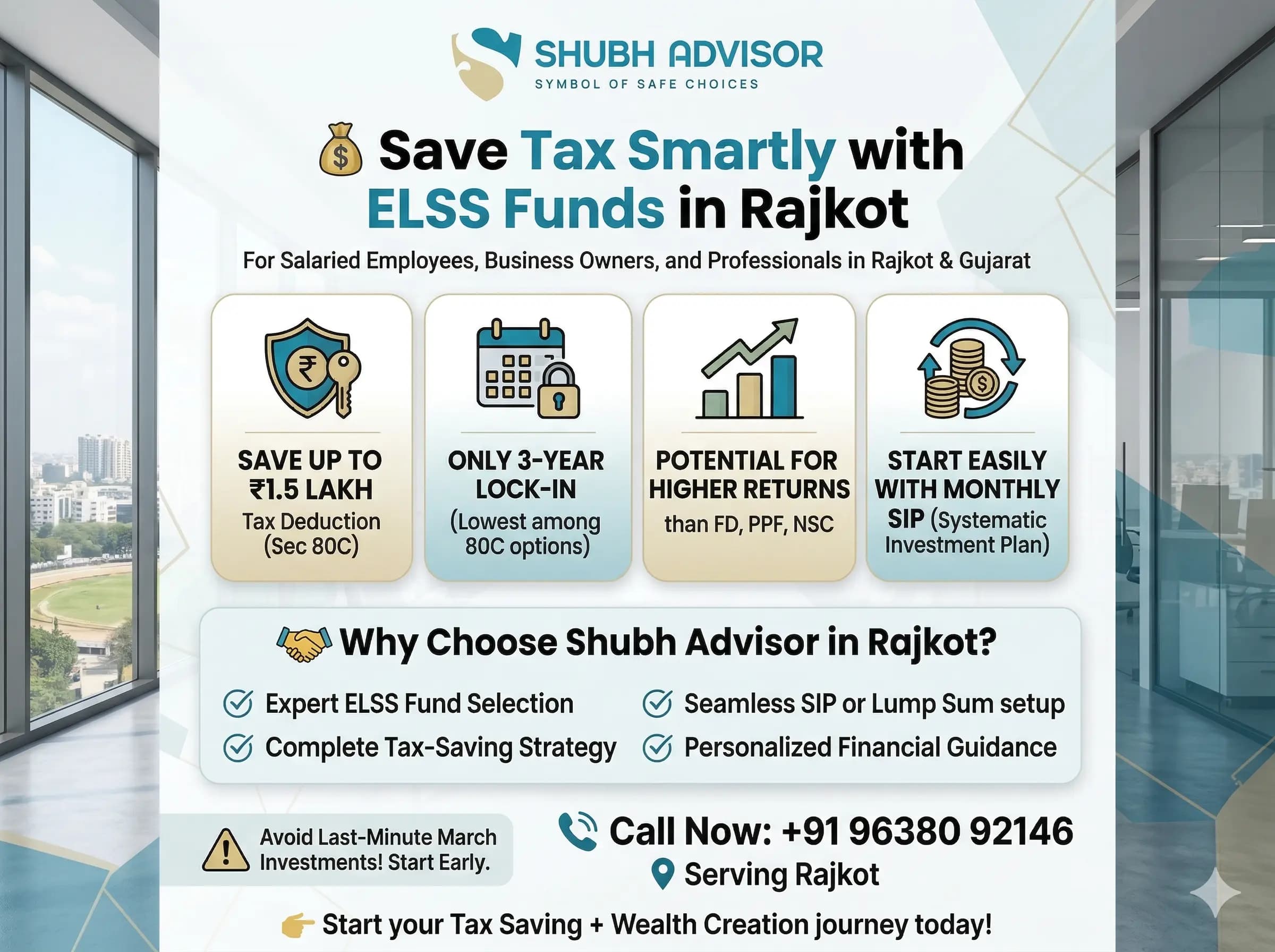
- Equity Funds: Invest primarily in stocks, offering high growth potential with higher risk. Categorised by market cap (large-cap, mid-cap, small-cap), sector, or theme. ELSS (Equity Linked Savings Scheme) is an equity fund with tax-saving benefits under Section 80C, popular for taxpayers in Gujarat.
- Debt Funds: Invest in fixed-income securities (bonds, money market instruments). Generally less volatile than equity funds, suitable for conservative investors or short-term goals.
- Hybrid Funds: A mix of equity and debt, aiming to balance growth and stability (e.g., balanced advantage, aggressive hybrid funds).
- Solution-Oriented Funds: Designed for specific goals like retirement or children's education.
- Index Funds/ETFs: Passive funds tracking a specific market index (e.g., Nifty 50), usually with lower expense ratios.
5. Evaluate Fund Performance and Consistency
While past performance is never a guarantee of future returns, it's a critical indicator. Look for consistent performance over various market cycles (bull and bear markets), not just during a short boom. Compare the fund's performance against its benchmark index and its peers in the same category. A fund consistently outperforming its benchmark and peers is generally a strong contender.
6. Consider the Expense Ratio
The expense ratio is the annual fee charged by the fund house to manage the fund, expressed as a percentage of your investment. A lower expense ratio means more of your money is working for you, potentially leading to higher returns over the long run. Even a small difference can significantly impact your corpus over decades.
7. Check the Exit Load
An exit load is a fee charged if you redeem your units before a specified period (e.g., 1% if redeemed within one year). Understand this clause, especially if you foresee needing your money back sooner. Some funds have no exit load.
8. Tax Implications
Mutual fund investments are subject to taxation. Understanding Capital Gains Tax (short-term vs. long-term) is essential. Equity funds held over 1 year attract Long Term Capital Gains (LTCG) tax at 10% on gains exceeding ₹1 lakh; Short Term Capital Gains (STCG) are taxed at 15%. Debt funds have different tax rules. ELSS funds offer tax benefits under Section 80C, making them attractive for those looking to save tax in Rajkot while investing.
9. SIP vs. Lumpsum Investment
You can invest in mutual funds via a Systematic Investment Plan (SIP) or a lumpsum amount. SIP involves investing a fixed amount regularly (e.g., monthly). It promotes financial discipline, averages out costs through Rupee Cost Averaging, and is ideal for long-term goal planning. Lumpsum investment is a one-time large investment, often preferred when you have a significant sum available and market conditions are favorable.
Benefits of Investing in Mutual Funds
Once you've chosen your fund wisely, you unlock a host of benefits:
- Diversification: Spreads your investment across multiple securities, reducing risk compared to investing in a single stock.
- Professional Management: Your money is managed by experienced fund managers who conduct research and make investment decisions on your behalf.
- Affordability: You can start investing with as little as ₹500 per month through SIPs.
- Liquidity: Most open-ended mutual funds allow you to redeem your investment whenever you need, with money typically credited within a few business days (subject to exit loads if any).
- Flexibility: Wide range of funds to suit different goals, risk profiles, and investment horizons.
Common Mistakes People Should Avoid
Even with the best intentions, investors sometimes make common errors. Be aware of these pitfalls:
- Chasing Past Returns: A fund that performed well last year might not do so this year. Focus on consistency and alignment with your goals.
- Ignoring Risk Tolerance: Investing in high-risk funds without assessing your comfort level can lead to panic selling during market dips.
- Lack of Diversification: Putting all your money into one type of fund or one sector increases concentrated risk.
- Investing Without a Goal: Without a clear objective, it's hard to choose the right fund or stay disciplined through market cycles.
- Panic Selling: Reacting emotionally to market volatility and selling during downturns often locks in losses. Patience is key in long-term investing.
- Not Reviewing Your Portfolio: Your goals and market conditions change. Periodically review your portfolio to ensure it still aligns with your objectives.
How Shubh Advisor Helps You Navigate Mutual Funds in Rajkot
Navigating the complexities of mutual funds can be challenging, especially when you have diverse financial aspirations and perhaps limited time. This is where a trusted local advisor like Shubh Advisor steps in. Based right here in Rajkot, we understand the specific needs and goals of individuals, families, and entrepreneurs across Gujarat.
At Shubh Advisor, our approach is personalized. We don't just recommend funds; we sit down with you to understand your financial goals, accurately assess your risk tolerance, and help you define a suitable investment horizon. We simplify jargon and provide clear, practical advice tailored to your unique situation. Our expertise spans a wide range of financial services, including mutual funds, SIPs, insurance, loans, income tax returns, and even passport services, offering a holistic approach to your financial well-being.
Choosing the right mutual fund becomes a smooth and confident journey with Shubh Advisor. We help you cut through the noise, ensure your portfolio is diversified appropriately, and guide you through market fluctuations, always keeping your long-term success in mind. Let us be your financial partner in achieving your dreams in Rajkot.
Conclusion
Investing in mutual funds can be a highly rewarding path to achieving your financial goals. By carefully considering your goals, risk tolerance, investment horizon, fund types, and performance, you can build a robust investment portfolio. Remember, patience, discipline, and informed decision-making are your greatest allies.
Don't let the vastness of options deter you. Take the first step towards a smarter financial future. For expert, personalized guidance on choosing mutual funds and comprehensive financial planning tailored to your needs in Rajkot, reach out to Shubh Advisor today. We are here to simplify your investment journey and help you build lasting wealth. Your financial success is our priority.